 info@barkatl.com

The Science Behind Your Dog’s Play Style
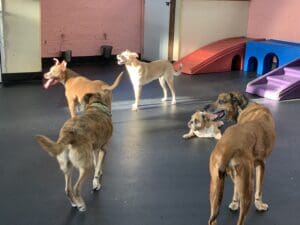
Walk into a dog daycare on any given day, and you might notice something interesting: not every dog plays the same way.
One dog is sprinting after a ball as if it were the most important mission of the day. Another is happily wrestling with a friend. A third is wandering around with its nose to the ground, investigating every scent it can find. Somewhere nearby, another dog may be carrying a toy around without any apparent intention of giving it back.
They are all playing. They just have very different ideas of what “fun” means.
At Bark ATL, this is one of the things that makes watching dogs interact so interesting. When you spend enough time around them, you begin to see that play is much more than dogs simply burning off energy. Play can involve movement, objects, exploration, communication, and social interaction, and individual dogs can show very different preferences.
So why does one dog love chasing a ball while another would rather wrestle with a friend?
The answer has a lot to do with who that dog is.
The Dog Who Lives for the Chase
For some dogs, a moving ball is nearly impossible to ignore. The moment it goes flying, they are off.
Fetch combines several behaviors that can be highly rewarding to dogs: watching movement, pursuing an object, picking it up and carrying it, and interacting with a person. Research has found that fetching is particularly common in dogs and that breed background can influence how likely a dog is to retrieve objects. Retrieving breeds, for example, show stronger tendencies toward fetching than some other breed groups.
A dog does not have to be a Labrador Retriever to love a tennis ball, and plenty of dogs will watch a perfectly good ball fly through the air and decide that it is somebody else’s problem.
That is because individual personality matters too. Research examining thousands of dogs has found that breed and age are associated with personality, but those factors explain only part of the variation between individual dogs. There is still plenty about a dog’s personality that is unique to that particular animal.
The Tug-of-War Enthusiast
Then there are the dogs who would happily spend an afternoon pulling on a rope.
Tug is different from fetch because the reward isn’t just the object. There is another participant on the other end. The dog gets to pull, grip, resist, reposition and interact with a person.
Studies of canine behavior have found meaningful differences between breeds in human-directed play, with some working and sporting groups showing particularly strong tendencies toward play with people. That makes sense when you consider how many breeds were historically developed to work closely alongside humans. Play could become part of the relationship between a dog and the person who directs or works with them.
For some dogs, social interaction is the best part.
The Dog Who Would Rather Wrestle
Walk into a well-matched group of dogs and you may see a completely different kind of play.
One dog lowers its front end into a play bow. Another responds. They bounce toward each other, run, turn, pause and start again.
That play bow is not random. Dogs use recognizable signals to communicate playful intentions, helping their play partner understand that the interaction is meant to be play rather than a serious confrontation. Research has identified play bows and other exaggerated movements as important social signals during canine play.
Social play also requires cooperation. Dogs respond to one another, adjust their movements and learn when to continue, slow down or take a break.
For dogs who love wrestling and physical play, having a playmate who enjoys that same style of interaction can make for a rewarding experience. When dogs are well matched in temperament, energy and play style, that back-and-forth can become one of the most natural and enjoyable ways for them to socialize, exercise and have fun.
The Detective
Some dogs aren’t interested in the ball. They’re interested in everything around the ball.
They sniff the grass. They investigate another dog’s scent. They stop at a new corner of the room and spend several seconds gathering information that humans cannot even perceive.
For dogs, scent is a major part of how they experience their environment. Olfactory enrichment has been associated with changes in behavior and can provide dogs with opportunities to explore and engage with their natural sensory abilities. Research into environmental enrichment has also found potential benefits for canine welfare and reductions in some stress-related behaviors.
To a person, a dog spending several minutes sniffing may look like nothing is happening.
To the dog, quite a lot may be happening.
So Why Does Your Dog Choose One Game Over Another?
There isn’t one answer.
A dog’s preferred style of play can be influenced by genetics, breed history, age, previous experiences, personality, environment and the individual rewards that a dog finds motivating. Research has found measurable genetic and breed-level differences in canine behavior, while also showing substantial variation between individual dogs.
A dog bred for retrieving may be especially interested in chasing and carrying objects. A dog with a strong history of working alongside people may enjoy interactive games with humans. Another dog may find social interaction with other dogs more rewarding, while another may prefer exploring its surroundings independently.
But none of these tendencies tell the entire story.
That is why good dog care isn’t simply about putting dogs together and letting them play.
Whether you’re looking for dog daycare in Atlanta, Downtown Atlanta dog boarding, or cage-free dog boarding, understanding individual dogs matters. Their size, energy level, confidence, temperament and preferred style of play can all influence how they interact with the dogs and people around them.
At Bark ATL, that’s part of what makes every day different. There isn’t one definition of a “good time” for every dog.
For one pup, happiness might look like sprinting after a ball. For another, it might be a game of tug. For another, it might be finding a new friend to wrestle with. And sometimes, the best part of the day is simply having the freedom to explore, sniff, relax and be themselves.
Because when you understand what makes a dog want to play, you begin to understand something much bigger:
Their favorite game is often a little window into who they are.
Quick Takeaways
- Every dog has their own unique way of play style.
- Breed, personality, age, and experience can all influence what they enjoy.
- Play provides more than just exercise, it also supports social, mental, and emotional well-being.
- Understanding how dogs like to play helps create happier, more enriching daycare experiences.
FAQ’s – Frequently Asked Questions
Does my dog’s breed impact what types of games they like to play?
Yes, breed can influence a dog’s natural play preferences, such as retrieving, chasing, tugging, or searching. However, personality, age, and individual experiences also play an important role.
How does a dog daycare and boarding facility foster and encourage play among dogs?
A good daycare provides opportunities for different types of play while considering each dog’s personality, energy level, and play style. The goal is to help every dog find activities they genuinely enjoy while boarding or at daycare.
Is it safe for my dog to play with other dogs at dog daycare?
When dogs are appropriately matched and properly supervised, social play can be a safe and rewarding experience. Factors like temperament, energy, confidence, size, and play style help determine appropriate play groups.
My dog has low energy and doesn’t like any of this. Is that normal?
Absolutely. Some dogs simply prefer calmer activities like sniffing, exploring, relaxing, or spending time with people, and that is completely normal.
September 3, 2026 in Uncategorized. Bookmark the permalink.
